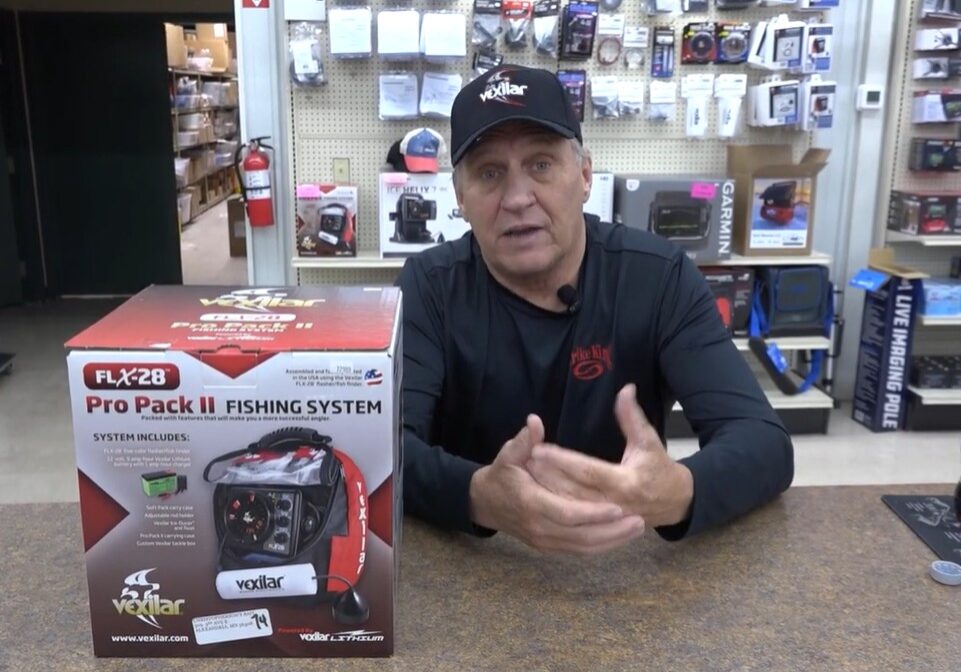

Fishing the Midwest’s Mike Frisch shares insight into finding and catching walleyes.
Up & Away!
By Mike Frisch, Fishing the Midwest
During my early career fishing for walleyes, I was taught a couple of “truths” regarding fish location. First, walleyes were bottom-oriented fish, so it was best to fish near the bottom. Second, walleyes were often found along structural elements like points, turns and weedlines, so those were the go-to areas. Over the years, however, we’ve learned those truths aren’t always true and that walleyes are often found in places we didn’t use to look.
The advent of Forward-Facing Sonar (FFS) technology has allowed anglers to efficiently find walleyes in a variety of locations. One location that has become especially popular is a lake basin. A basin is a flat-bottomed area containing some of a lake’s deepest water, where walleyes roam away from structure. Not only are these fish away from any change in water depth, but they’re often suspended in the water column, sometimes not far below the surface. Some anglers who use FFS refer to these fish as “floaters” because they appear randomly, often one at a time, seemingly floating in no-man’s land. Though random and sometimes difficult to locate, floaters are often some of the biggest walleyes in the lake.
On a recent outing, for example, a fishing partner and I were on a shallow lake searching a basin with water depths of around 20 feet. We moved quickly, relying on our ActiveTarget 2 XL FFS unit to scan up to 80 feet in front of the boat. Occasionally, we’d spot a fish, often suspended 5 to 10 feet off the bottom. We’d hold the boat, cast past the fish and slowly work our baits over it. Several fish were willing biters, and we had a great time catching big walleyes. We caught fish on a couple of different baits, but our two biggest—a pair of females measuring just over 26 inches—came on a 3X Z-Too soft bait rigged on a ¼-ounce jig.
Utilizing FFS is one way to target walleyes away from structure, particularly those suspended in the water column. On another outing, I found fish holding closer to the bottom away from structure using traditional 2D sonar.
I was cruising an underwater point looking for walleyes on sonar. As I reached the end of the point, I slid into the basin where the lake flattened out in about 24 feet of water and started marking what I believed were walleyes. I continued scanning at least 50 yards beyond the point and saw a good number of marks on sonar. An initial fishing pass confirmed they were walleyes. A plain rig—a heavy bottom bouncer paired with a plain fluorocarbon snell and two hooks tipped with a nightcrawler—put several walleyes in the boat. When that bite slowed, we caught a few more by suspending nightcrawlers on small jigs beneath bobbers.
Whether you prefer today’s modern technology or traditional sonar to locate walleyes, spending time looking up in the water column and away from structure is sound advice. Good luck with your walleye search, and as always, remember to include a youngster in your next outdoor adventure!